
.png)
.png)
.png)

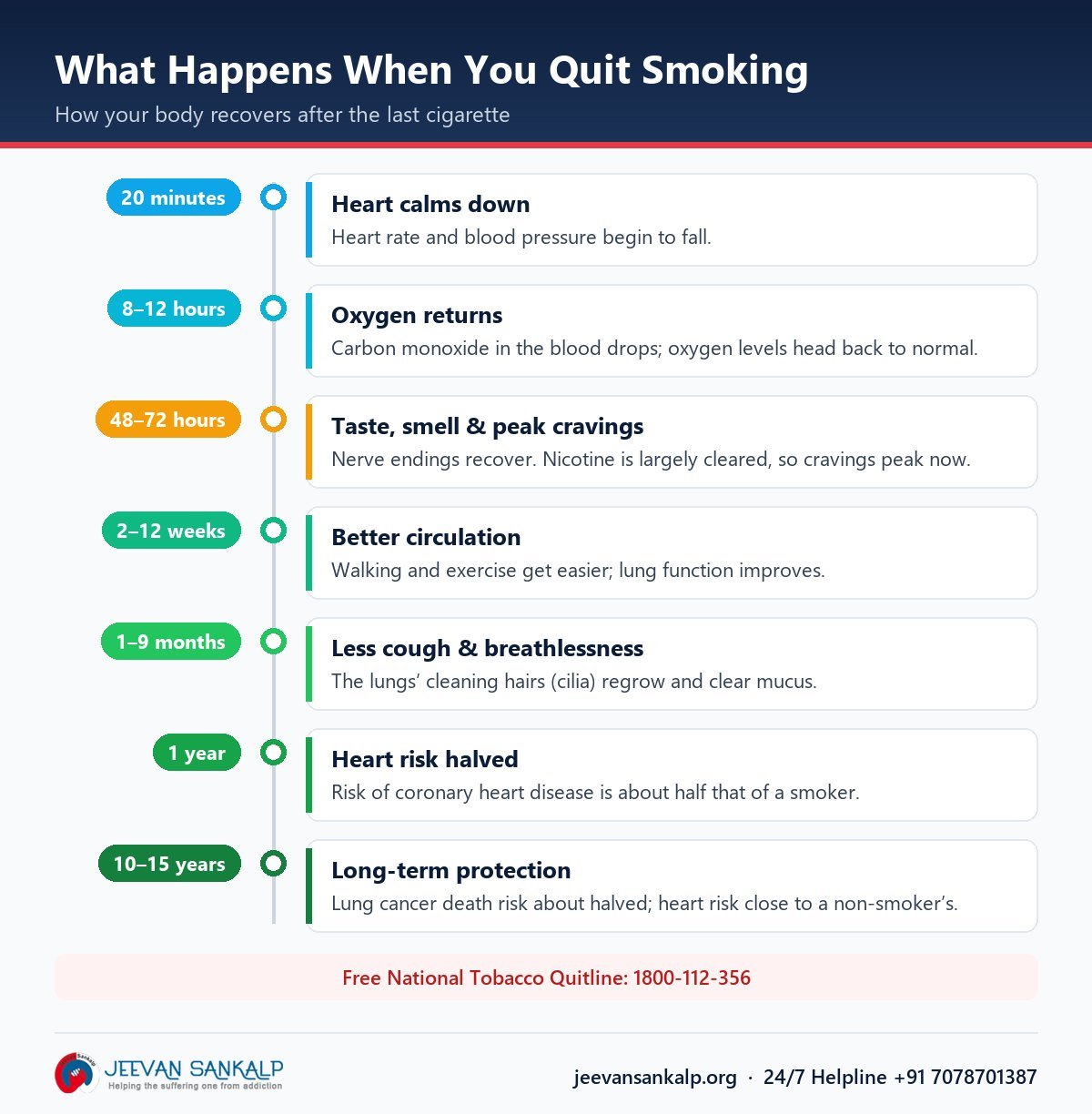
The moment you stub out your last cigarette, your body starts repairing itself. Some changes happen within minutes, others take years. And yes, the first few days can be uncomfortable. Knowing exactly what to expect makes it far easier to push through.
Here is an honest, day-by-day guide to what happens when you quit smoking: the benefits, the side effects of quitting suddenly, and how to cope.
The big picture
- Benefits start within 20 minutes and keep building for 15 years or more.
- Withdrawal side effects usually peak in the first 3 days and ease within 2 to 4 weeks.
- Quitting suddenly is safe for your body. The challenge is cravings, not danger.
Quit Smoking Timeline: The Benefits
| Time since last cigarette | What happens in your body |
|---|---|
| 20 minutes | Heart rate and blood pressure begin to fall. |
| 8 to 12 hours | Carbon monoxide in the blood drops; oxygen levels return towards normal. |
| 24 hours | Nicotine levels are falling sharply; the strain on the heart begins to ease. |
| 48 hours | Nerve endings start to recover; taste and smell begin improving. |
| 72 hours | Nicotine is largely cleared from the body. Breathing may feel easier, but cravings are often strongest now. |
| 2 to 12 weeks | Circulation improves; walking and exercise become easier; lung function improves. |
| 1 to 9 months | Coughing and breathlessness decrease as the lungs' cleaning hairs (cilia) regrow. |
| 1 year | Risk of coronary heart disease is about half that of a smoker. |
| 5 years | Risk of mouth, throat and oesophagus cancers is roughly halved; stroke risk keeps falling. |
| 10 years | Risk of dying from lung cancer is about half that of a person who still smokes. |
| 15 years | Risk of heart disease is close to that of someone who never smoked. |
To see what smoking was doing to each organ in the first place, read smoking effects on your body.
Day by Day: The First Week After Quitting
Day 1
You will probably feel motivated but restless. Cravings come every hour or so, especially at your usual smoking times: after tea, after meals, and on the toilet. Your oxygen levels are already improving.
Day 2
Irritability and anxiety rise. You may feel hungry, tired and unable to concentrate. Some people get headaches. This is nicotine withdrawal, and it is temporary.
Day 3
Often the hardest day. Nicotine has largely left your body and cravings can be intense. Some people feel low, short-tempered or have trouble sleeping. If you get through day 3, you have passed the peak.
Days 4 and 5
Physical symptoms start to ease, though cravings still hit around triggers. Many people notice food tastes better and they cough up more mucus. That is the lungs clearing out, which is a good sign.
Days 6 and 7
Energy starts to return. Cravings become less frequent but can still be strong, especially around stress, alcohol or other smokers. Celebrate one week. It is a real achievement.
Weeks 2 to 4
Most physical withdrawal settles. Mood, sleep and concentration improve. Occasional strong cravings may still appear, but they pass within a few minutes.
Side Effects of Quitting Smoking Suddenly
Quitting "cold turkey" is not dangerous for your body, but it can be uncomfortable. Common side effects include:
- Cravings: they usually last 5 to 10 minutes each time, then fade.
- Irritability and anger: warn your family in advance.
- Anxiety and low mood: usually temporary. If you have a history of depression, tell your doctor before quitting.
- Difficulty concentrating for the first two weeks.
- Increased appetite and weight gain: many quitters gain a few kilograms, which is far less harmful than continuing to smoke.
- Sleep changes and vivid dreams.
- Coughing as the lungs clear (temporary).
- Constipation and, occasionally, mouth ulcers.
See a doctor if a cough lasts more than three weeks, if you cough up blood, or if you feel severely depressed after quitting.
How to Get Through Withdrawal: Practical Tips
- Use the 4 Ds: Delay (wait 10 minutes), Deep breathe, Drink water, Do something else.
- Change your routine: if you smoked with morning chai, switch the cup, place or time for a few weeks.
- Avoid alcohol in the first month, because it is one of the biggest relapse triggers.
- Keep your hands and mouth busy with saunf, cardamom, carrot sticks or sugar-free gum.
- Move: a 10-minute walk reduces craving intensity.
- Tell people you are quitting and ask friends not to smoke around you.
- Consider nicotine replacement: patches or gum can halve the discomfort. See quit-smoking medicines and nicotine patches.
- Call India's free National Tobacco Quitline on 1800-112-356 for counselling support.
For more strategies, read 10 proven ways to stop smoking.
What If You Slip?
One cigarette does not mean you have failed. Most smokers need several attempts before they quit for good. Treat a slip as a lesson: what triggered it, and what will you do differently next time? Then continue your quit, ideally the same day.
If you have tried many times and keep relapsing, structured support helps. Nicotine is genuinely one of the most addictive substances (read why smoking is so hard to quit). Jeevan Sankalp offers a counselling-based tobacco de-addiction programme in Dehradun, and families can read how to help a family member quit.
Frequently Asked Questions
What happens to your body when you quit smoking?
Within 20 minutes your heart rate drops. Within 12 hours carbon monoxide levels fall. In 2 to 12 weeks circulation and lung function improve. After 1 year heart disease risk halves, and over 10 to 15 years cancer and heart risks fall dramatically.
What are the side effects of quitting smoking suddenly?
Common side effects are cravings, irritability, anxiety, low mood, poor concentration, increased appetite, sleep changes and a temporary cough. They peak in the first 3 days and usually ease within 2 to 4 weeks.
Is it safe to quit smoking suddenly?
Yes. Quitting cold turkey is safe for your body. Withdrawal is uncomfortable but not dangerous. Using nicotine replacement or medicines can make it easier and more successful.
Which day is the hardest when you quit smoking?
For most people, days 2 to 3 are the hardest, because nicotine has left the body and cravings peak. Symptoms gradually ease after the first week.
How long do nicotine cravings last after quitting?
Each craving usually lasts only a few minutes. Frequent cravings settle within 2 to 4 weeks, although occasional triggered cravings can appear for months.
Will I gain weight if I quit smoking?
Many people gain a few kilograms because appetite returns and metabolism changes. Regular activity and healthy snacks help, and the health benefits of quitting far outweigh the weight gain.
This article is for awareness and education. It does not replace a consultation with a doctor. Please do not start, stop or change any medicine without medical advice.
Need Help for Yourself or a Loved One?
Talk to our counsellor in complete confidence. We are available 24/7.
+91 7078701387 WhatsApp